
Do we actually have any evidence that posterior wall isolation doesn’t work?

Question:

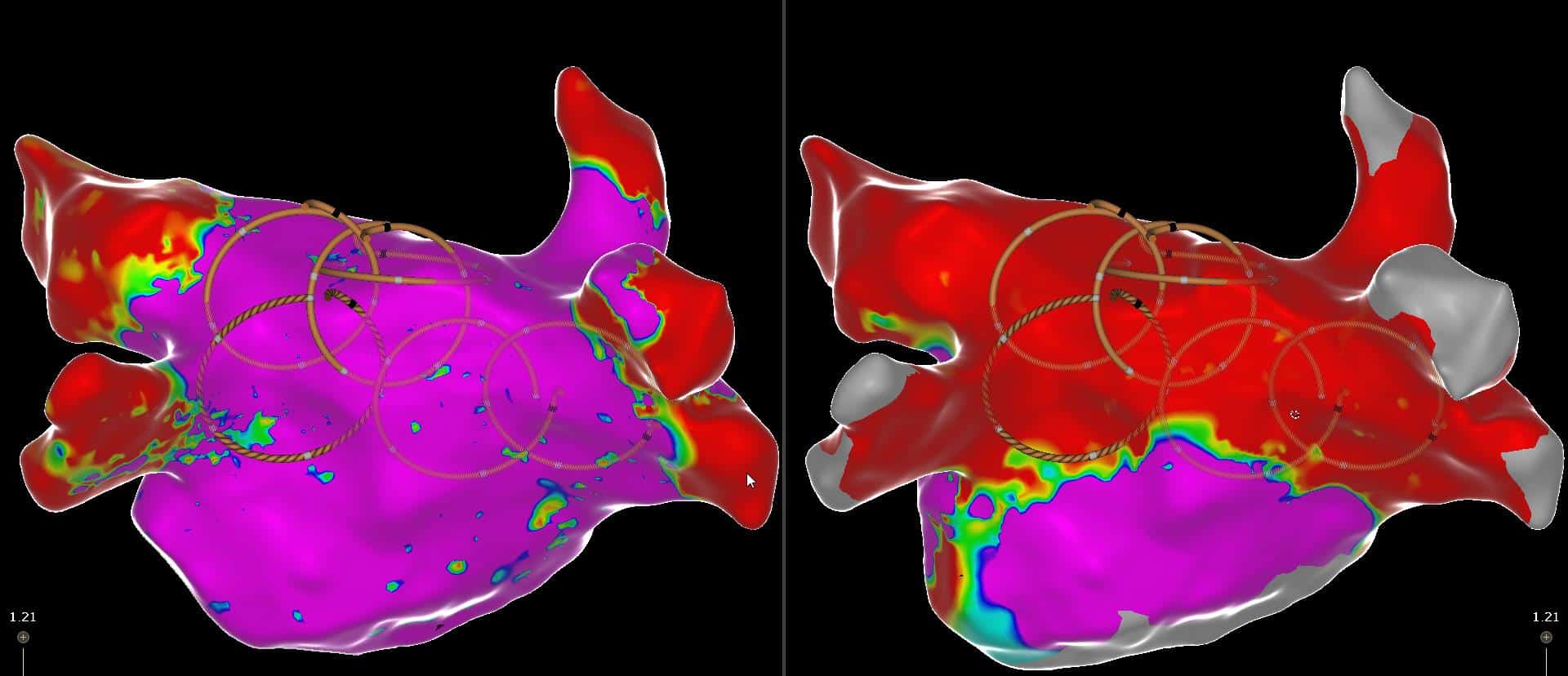
The patient is back with persistent AF. You remap the left atrium and all four veins are still isolated. The usual next step in a lot of labs is to isolate the posterior wall.

Everyone says the evidence is in, and posterior wall isolation doesn't work. Is that true for this patient?

(Click to zoom on image)

Answer:

At a first-time ablation, adding posterior wall isolation (PWI) to pulmonary vein isolation (PVI) hasn’t been shown to reduce recurrence. The main randomised trials (CAPLA, PIFPAF-PFA and PIVoTAL) were all neutral on their primary endpoint. For the patient above, with four durably isolated veins and AF anyway, nobody knows, because no completed randomised trial has tested PWI against doing nothing, a sham or drugs in that patient.

“There’s plenty of evidence against posterior wall isolation.” – Total bollocks

That statement is not the same as saying there’s evidence against PWI in the patient where we actually use it. Everyone accepts that PVI is the cornerstone of AF ablation, and nobody disputes that.


The trials people quote when they say PWI “doesn’t work” asked a different question: should PWI be added at a first ablation? They did not ask what to do when the veins are already isolated and the AF is still there.

1. Who was actually in CAPLA and the other PWI trials

  • CAPLA = first time AF ablation. Randomised 338 patients with persistent AF (170 PVI + PWI, 168 PVI alone), all at a first-time ablation. At 12 months, 52.4% vs 53.6% were free of atrial arrhythmia, and it was still neutral at 3 years.


  • PIFPAF-PFA = first time AF ablation. 206 patients, pulsed field, loop recorder in everyone. Negative.
  • PIVoTAL = first time AF ablation – 153, cryoballoon. Negative.


  • The only randomised redo trial of posterior box isolation I could find (RILI, 150 patients) enrolled patients whose veins had reconnected, which is the opposite of the patient in the question…wtf do we do with a patient who has persistent AF despite durably isolated veins? 


Table of posterior wall isolation studies by population. The main randomised trials were first-time ablations, the redo trial had reconnected veins, the durable-vein studies were observational, and the one durable-vein randomised trial stopped after 8 patients.
Who was in the posterior wall isolation trials. Sources listed under the table.


2. The posterior wall isolation trials never actually isolated the posterior wall

  • In the CAPLA study patients who returned to the lab due to persistent AF following posterior wall isolation: 75% of them had posterior wall reconnection. That means 75% of them had a failed posterior wall isolation.

    Granted this is a huge selection bias because it’s patients who came to the lab because they had persistent AF despite an attempted posterior wall isolation and it’s not mandated mapping in all patients. However if this is anything at all, it’s a signal that posterior wall isolation is actually really difficult with current technologies.

  • It’s interesting that the CONVERGE study, which used both epicardial and endocardial ablation techniques, managed to durably isolate the posterior wall. In this study posterior wall isolation actually improved AF survival compared to no posterior wall isolation.Together these two points hint or suggest to me that posterior wall isolation can actually be effective for some patients if you manage to actually isolate the posterior wall. But we are very, very, very poor at durably isolating the posterior wall using endocardial ablation techniques.

    This is because of the increased thickness of the LA roof, the epicardial septopulmonary bundle, and also the intramural adipose tissue, which separate the endo- and epicardial layers at the left atrial dome (discussed in the septopulmonary bundle box).

3. The veins drown out the signal

  • In Haïssaguerre’s original work, 65 of 69 triggering foci (94%) sat in the pulmonary veins. That tells us that most of the time, the veins are the problem. So a first-time AF ablation trial that includes PVI must theoretically produce massive numbers to detect a change in efficacy with posterior wall isolation (since the effect of posterior wall isolation in most patients is probably small, since the veins are responsible for the vast, vast, vast majority of AF triggers).


  • CIRCA-DOSE put a loop recorder in before and after PVI alone, in first-time, mostly paroxysmal patients. Median AF burden fell by 99.3% (RF), 99.9% and 98.4% (the two cryoballoon arms).


  • In CAPLA, median AF burden at 12 months was 0% in both arms. If PVI alone leaves a median burden of 0%, PWI can’t improve the median. Nobody should expect it to.


  • AF isn’t really that curable. Data has consistently shown around half of patients have demonstrable recurrence if implanted with a loop recorder and watched for a long enough time period following PVI. Expecting an extra lesion set to raise the “cure” rate for all patients, when the veins are usually driving the AF for the vast majority of patients, is probably inconsistent with reality.
    • However there may be a subgroup of patients whose postural war is directly responsible for driving or initiating their atrial fibrillation. In these patients postural wall isolation may be effective and pulmonary vein isolation may not be particularly effective, perhaps explaining why some patients come back to the lab despite durably isolated veins, at least in theory.

4. PWI at redo ablation with durably isolated veins

  • In a lot of the labs I work in, persistent AF with all veins isolated means the posterior wall gets isolated. To my knowledge, nobody has shown benefit or harm from that in this patient.


  • The trial that tried to answer it, TRAP-AF (Penn), randomised first redos with durably isolated veins and no inducible triggers to CTI ablation plus drug adjustment, PWI, or empiric trigger ablation. It was terminated after 8 patients for lack of enrolment.


  • RABLAP-AF, a first-time trial with a burden-based primary endpoint (time to the first day with at least 12 hours of AF), was withdrawn before enrolling anyone, citing “new evidence” that PWI isn’t effective.


  • The small observational redo studies (the Netherlands registry, PARTY-PVI and a Japanese cohort) lean against empiric PWI. But the strategy was operator-chosen, the numbers are small, the endpoint is time to first recurrence, and only one had a meaningful do-nothing group (33 patients). They’re weak signals, not evidence against.


  • The critics are flying in an evidence-free zone. So are those of us who isolate the wall in this patient.


4. PWI isn’t free: does it cause atrial flutter?

  • A meta-analysis of 9 randomised trials in non-paroxysmal AF (1,243 patients) found more atrial tachycardia and flutter recurrence with PWI (RR 1.62). Another pooled analysis showed only a trend, so the size of the risk isn’t settled. The direction is consistent, though, and it fits with gaps in a box creating channels for re-entry. In one PFA series, 3 of the 4 patients whose posterior wall had reconnected presented with roof-dependent atrial tachycardia.
  • So in the durable-vein patient we might be swapping AF for iatrogenic macroreentrant flutter. Maybe the right move is to do nothing and take the catheter out. Nobody has studied it, and that’s the big problem.


We go through the trials, the anatomy and the practical challenges of posterior wall isolation in EP in Practice – Program 5: Atrial Fibrillation.

My two cents:

  • What’s almost certain is that most patients with paroxysmal or persistent AF at a first-time ablation should not get empiric PWI. There are single-center randomized studies which have demonstrated a reduced AF recurrence and an increased flutter recurrence following posterior wall isolation plus PVI.


  • The negative trials answered that first-time question. They never studied the patient with durably isolated veins and ongoing AF.


  • In that patient, PWI might help, might do nothing, or might cause harm through extra flutters. We don’t really know.


  • A median burden of 0% after PVI is a high bar to improve on. If PWI has a role, it’s in a smaller group, measured with continuous monitoring and burden. Or patients who have AF despite durable pulmonary vein isolation. At this stage the evidence suggests that it’s likely not that helpful for first-time customers


  • The trial we need: durable PVI at redo, randomised to PWI vs no further ablation (or drugs), loop recorder, burden as the primary endpoint.

Thanks for tuning in :)

Cheers Mitch & CPiP Team


References

  1. Kistler PM et al. CAPLA. JAMA 2023;329:127–135. PMID 36625809
  2. William J et al. CAPLA long-term outcomes. Eur Heart J 2025;46:132–143. PMID 39215996
  3. Andrade JG et al. CIRCA-DOSE. Circulation 2019;140:1779–1788. PMID 31630538
  4. Haïssaguerre M et al. Spontaneous initiation of AF by ectopic beats originating in the pulmonary veins. N Engl J Med 1998;339:659–666. PMID 9725923
  5. Roten L et al. PIFPAF-PFA. JAMA 2026 (online 29 Aug). PMID 42667231
  6. Aryana A et al. PIVoTAL IDE. Heart Rhythm 2026;23:1695–1704. PMID 40840576
  7. Kim D et al. Posterior box isolation in repeat ablation (RILI). JACC Clin Electrophysiol 2022;8:582–592. PMID 35589170
  8. Magni FT et al. Repeat ablation with durably isolated PVs, Netherlands Heart Registration. Neth Heart J 2026;34:107–116. PMID 41670906
  9. Benali K et al. PARTY-PVI. Circ Arrhythm Electrophysiol 2023;16:e011354. PMID 36802906
  10. Egami Y et al. Induction test-guided ablation improves clinical outcomes in recurrent AF and durable PVI. J Cardiovasc Electrophysiol 2026;37:126–136. PMID 41291976
  11. Li Z et al. Adjunctive PWI in non-paroxysmal AF: meta-analysis of RCTs. Cardiology 2025;150:427–436. PMID 39647469
  12. Kueffer T et al. Posterior wall ablation by PFA: findings on redo procedures. Europace 2024;26:euae006. PMID 38225174
  13. TRAP-AF. ClinicalTrials.gov NCT05185310 (terminated). RABLAP-AF. NCT05195268 (withdrawn).

Leave a Reply

Subscribe to stay informed

Get the latest updates and event details, and be notified when new courses launch.