Unexplained Syncope – Sent for an Exercise Stress Test

Question:

44-year-old male with a history of unexplained syncope associated with fever due to a viral illness.

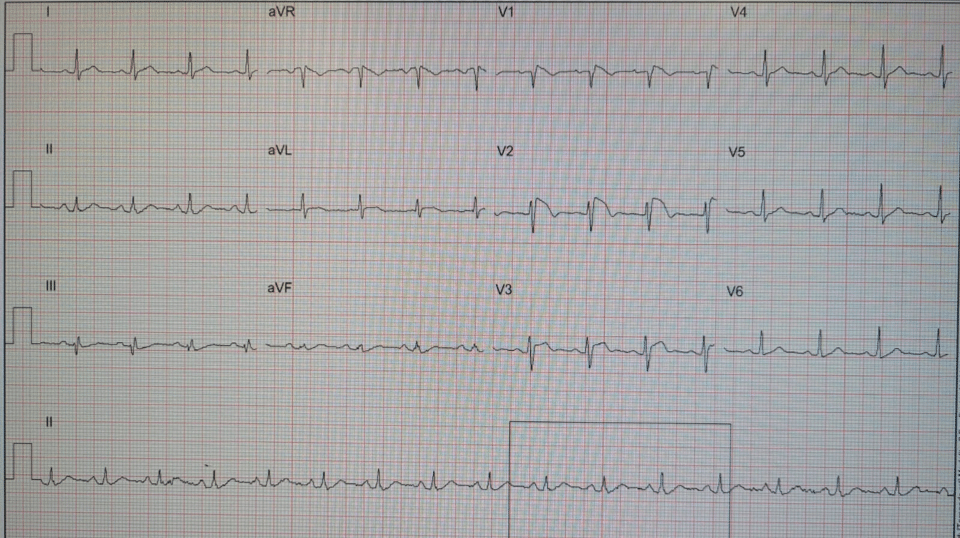
Referred to an Exercise Stress Test for non-invasive assessment of coronary artery obstruction. Given the pre-EST ECG, is the diagnosis already made?

(Click to zoom on image)

Answer:

Answer: Spontaneous Type 1 Brugada ECG pattern present V1-V2 (most prominent in V2). With a history of unexplained syncope, a diagnosis of Brugada Syndrome should be considered (depending on the history/features of the syncopal event).


Clearing up misconceptions: Brugada Syndrome Vs Brugada ECG pattern

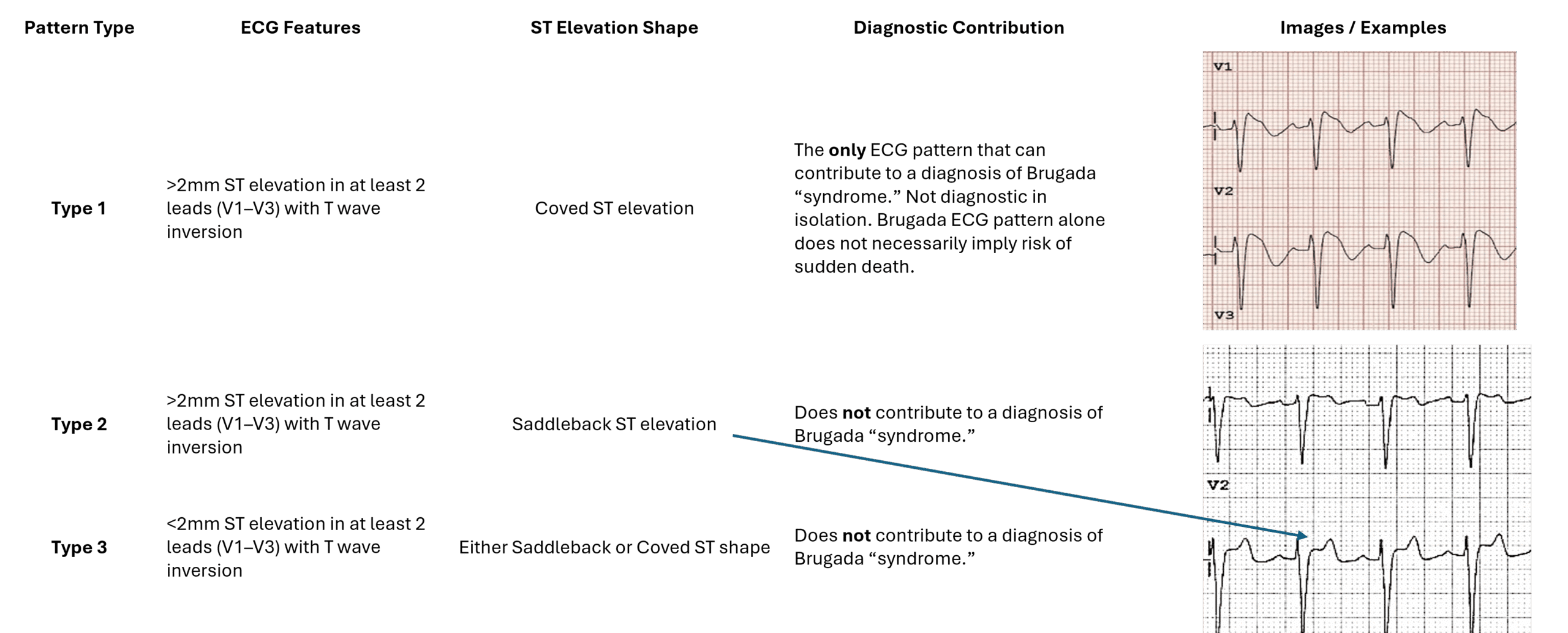
Brugada “ECG pattern”

  • Refers to a specific ECG feature in V1-V3
  • There are 3 types of Brugada ECG patterns


Brugada “Syndrome”

  • A genetic disorder with mutated sodium channel putting someone at risk of VF – (although a genetically mutated sodium channel can only be found in a minority of cases!).


Refers to someone who has:

  • Type 1 Brugada ECG pattern AND symptoms suggestive of aborted sudden cardiac death (VF) – most circumstances. Although in some circumstances, the Type 1 Brugada ECG pattern alone may make you suspicious of the “syndrome” being present depending on the patients history.


  • Some guidelines accept Spontaneous Type 1 Brugada ECG pattern as possible “Brugada Syndrome” – just with a lower risk of sudden death in the absence of risk factors such as a history of syncope.


Types of Brugada ECG patterns


Type 2 or Type 3 Brugada ECG pattern CANNOT be Brugada syndrome unless a type 1 ECG pattern has been observed/manifested with medication.


Brugada Syndrome Overview

Brugada “syndrome” is usually diagnosed in the presence of a type 1 ECG pattern & a history of symptoms, either:

  • VF, PMVT
  • Family Hx SCD <45yrs old (in some circumstances)
  • Nocturnal agonal respiration – (this is basically nocturnal “gasping” due to hypoxia resulting from VF)
  • Syncope


Congenital channelopathy that increases a person’s risk of ventricular fibrillation.

  • Purportedly responsible for up to 20% of all sudden cardiac death in patients without structural heart disease.


  • Mean age of presentation is around 40yrs and has a strong male predominance.


  • Sudden Cardiac Death may be first presentation.


Circadian relationship with VF episodes

The Brugada ECG pattern is DYNAMIC, transient and variable and can change by the hour.

    • For example, patients who present with Type 2 Brugada ECG pattern, may present with Type 1 Brugada pattern an hour later during an afternoon nap, and then revert back to type 2 ECG pattern when they wake up.


Type 1 Brugada ECG pattern is more likely to occur during:

    • High vagal tone periods (Sleep – hence the term “Thailand sleeping sickness” or “Lai Tai” named due to it’s prevalence in South East Asians where “healthy” males gasp for air at night (due to VF induced hypoxia) and die.
    • Febrile states/raised body temperature.


  • A spontaneous Type 1 Pattern with an increased ST elevation magnitude is indicative of a greater transmural voltage gradient/heterogeneity.
    • Associated with increased risk of phase 2 re-entry, ventricular fibrillation and sudden death.


  • Given many spontaneous Type 1 Brugada ECG patterns occur during periods of high vagal tone, it follows that there is a nocturnal clustering of VF episodes in patients with diagnosed Brugada Syndrome. See the graph below – (although there’s a lot of variability).


Treatments

Patients with T1 Brugada ECG pattern and a history of syncope due to likely VF, or documented VT/VF are often treated with an ICD.

  • Quinidine may be useful as an adjunct to controlling life threatening arrhythmias in patients with Brugada syndrome, however there is not a strong evidence base and it can be poorly tolerated by some patients.


  • Case series demonstrate some support for Quinidine as an adjunct therapy but randomised control trials  are impractical (due to low event rates – QUIDAM study).


  • Brugada Ablation is an interesting, unusual and somewhat exciting procedure with some evidence of success, however, that is a topic of another BeatBox :)


Entirely asymptomatic patients with an incidental Brugada pattern ECG are often managed conservatively if they lack symptoms or risk factors. An ECG alone is not usually sufficient to determine a patients risk of VF or their need for ICD therapy. More information is usually needed. 


My Two Cents: 

  • Brugada ECG Pattern relapses and remits throughout the day according to a patient’s vagal tone and body temperature.
    • VF episodes & Type 1 Brugada ECG patterns are more likely to occur at night time.


  • Type 1 Brugada ECG pattern is the only ECG pattern which can contribute to a diagnosis of Brugada Syndrome if symptoms are present.


  • A Type 1 ECG alone is not usually diagnostic of Brugada Syndrome & a high risk of VF (unless there is some other reason to be suspicious like a strong family history). Usually there also needs to be a history of unexplained syncope, aborted VF episodes or other signs or symptoms in the patient’s history to support a diagnosis of Brugada Syndrome.


  • If risk factors for VF are present (Syncope/Nocturnal agonal respiration/prior VF) then Brugada Syndrome is often treated with an ICD, and Quinidine may be used as an adjunct therapy in some cases.


This BeatBox post was based on content contained in ECG in Practice

ECG in Practice – Product Overview


References:

  • Al-Khatib SM, Stevenson WG, Ackerman MJ, Bryant WJ, Callans DJ, Curtis AB, Deal BJ, Dickfeld T, Field ME, Fonarow GC, Gillis AM, Granger CB, Hammill SC, Hlatky MA, Joglar JA, Kay GN, Matlock DD, Myerburg RJ, Page RL. 2017 AHA/ACC/HRS Guideline for Management of Patients With Ventricular Arrhythmias and the Prevention of Sudden Cardiac Death: Executive Summary: A Report of the American College of Cardiology/American Heart Association Task Force on Clinical Practice Guidelines and the Heart Rhythm Society. J Am Coll Cardiol. 2018 Oct 2;72(14):1677-1749.


  • Brugada Syndrome Phenotype Elimination by Epicardial Substrate Ablation Josep Brugada, Carlo Pappone, Antonio Berruezo, Gabriele Vicedomini, Francesco Manguso, Giuseppe Ciconte, Luigi Giannelli, and Vincenzo Santinelli: Circulation: Arrhythmia and electrophysiology 2015.


  • Mazzanti, A., Tenuta, E., Marino, M., Pagan, E., Morini, M., Memmi, M., Colombi, B., Tibollo, V., Frassoni, S., Curcio, A., Raimondo, C., Maltret, A., Monteforte, N., Bloise, R., Napolitano, C., Bellazzi, R., Bagnardi, V., & Priori, S.G. (2019). Efficacy and Limitations of Quinidine in Patients With Brugada Syndrome. Circulation: Arrhythmia and Electrophysiology.


  • Probst V, Veltmann C, Eckardt L, et al. Long-term prognosis of patients diagnosed with Brugada syndrome: Results from the FINGER Brugada Syndrome Registry. Circulation. 2010;121(5):635-643.


  • Antzelevitch C, Brugada P, Borggrefe M, Brugada J, Brugada R, Corrado D, Gussak I, LeMarec H, Nademanee K, Perez Riera AR, Shimizu W, Schulze-Bahr E, Tan H, Wilde A. Brugada syndrome: report of the second consensus conference: endorsed by the Heart Rhythm Society and the European Heart Rhythm Association. Circulation. 2005 Feb 8;111(5):659-70.


  • Matsuo K, Kurita T, Inagaki M, Kakishita M, Aihara N, Shimizu W, Taguchi A, Suyama K, Kamakura S, Shimomura K. The circadian pattern of the development of ventricular fibrillation in patients with Brugada syndrome. Eur Heart J. 1999 Mar;20(6):465-70.


  • Brugada R , Brugada J, Antzelevich C, et al. Sodium channel blockers identify risk for sudden death in patients with ST-segment elevation and right bundle branch block but structurally normal hearts. Circulation2000;101:510


  • Manohar, S., Dahal, B. R., & Gitler, B. (2015). Fever-Induced Brugada Syndrome. Journal of investigative medicine high impact case reports3(1), 2324709615577414.

Leave a Reply

Subscribe to stay informed

Get the latest updates and event details, and be notified when new courses launch.