
Frustrating Non-sustained SVT

Question:

During an SVT study, an SVT was repeatedly non-sustained and spontaneously terminated resulting in the following EGMs. No manoeuvres could be successfully performed. Given the EGM, can any inferences be made about the likely SVT sub-type?

(Click to zoom on image)

Answer:

Answer: A (visually) long VA time makes slow/fast AVJRT unlikely. Spontaneous termination with the atrium as the last EGM of tachycardia makes Focal AT unlikely.

  • So Fast/Slow AVJRT & Orthodromic AVRT utilising a Posteroseptal Accessory Pathway are possible.


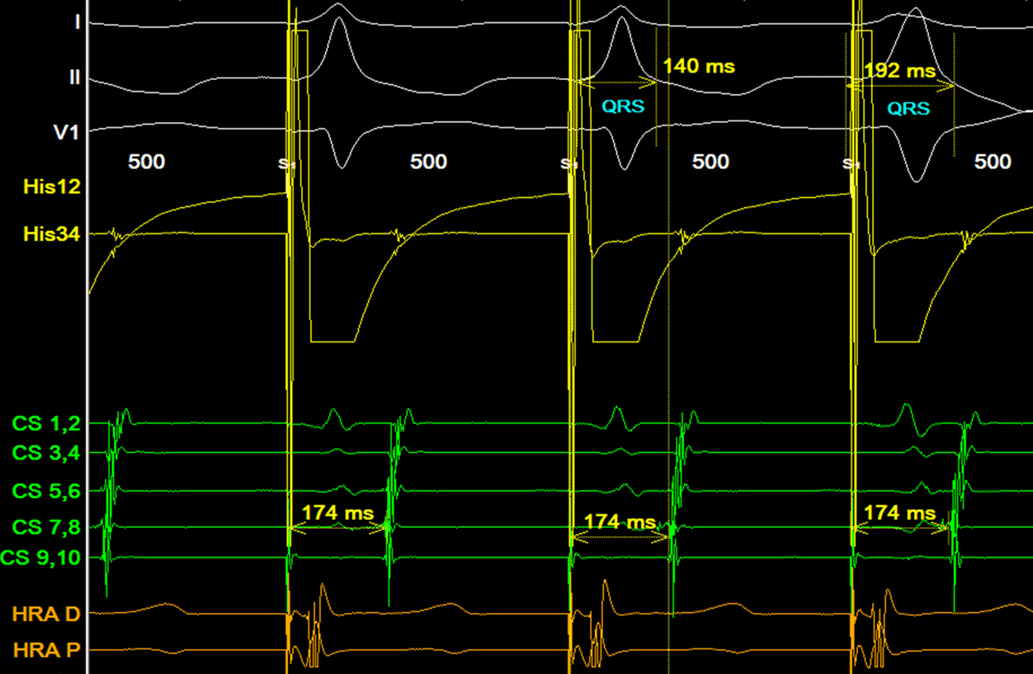
  • Did you notice the Pathway potential in CS 7,8? Yes – this was AVRT.


Spontaneous Termination:

  • Tachycardias that are entirely atrial (such as Focal AT or AFL) usually conduct to the ventricle after termination, resulting in the last EGM of tachycardia being a Ventricular EGM.


  • Tachycardias which utilise both Ventricular & Atrial Tissue (AVRT) or arise from the AV/His Junction (AVJRT/JET) can terminate in either chamber (so the last EGM of tachycardia can be either an A or a V EGM).


So… given the scenarios above, we can infer the following:

  1. Termination in the Ventricle – tells us very little. Focal AT, AVJRT and AVRT all commonly terminate with the last EGM of tachycardia being a V EGM.
  2. Termination in the Atrium – Very unlikey Focal AT. AVJRT/AVRT/JET are all still possible.


So what was the Tachycardia?

  • ORT utilising a posteroseptal accessory pathway.


  • The astute of you may have noticed an accessory pathway potential in CS 7,8. Sorry to say that when I did this case many years back, I missed it for a long time, delaying the diagnosis of the SVT :(
    • Whilst not diagnost of ORT, the presence of an accessory pathwya potential preceding Atrial EGMs during SVT is VERY suspicious of an AVRT.

For the people who doubt that circled EGM is a pathway potential, here is the result of our parahisian pacing.
Looking at another scenario:

 1.


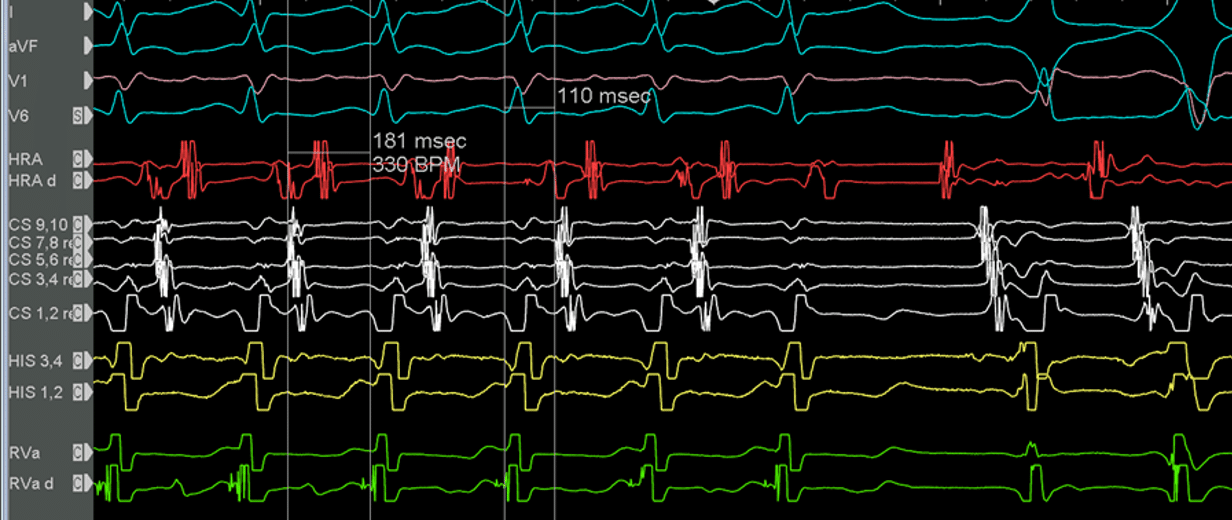
The Above EGM demonstrates a narrow complex tachycardia with a VA time of 110ms and eccentric atrial activation. This is strongly suspicious for ORT.


  • Why not other tachycardias?
    • Focal AT is possible, however, this is a short RP tachycardia (RP interval longer than the PR interval), which is not a typical characteristic of Focal AT which is usually a long RP tachycardia.
    • Atypical AVJRT is unlikely, because fast/slow AVJRT has the earliest atrial EGM in the Proximal CS in the slow pathway region, which is not seen here where CS 5,6 is earliest.


Termination occurs in the Ventricle in this scenario. What does this tell us?

  • Basically nothing, because Focal AT, AVJRt and AVRT all can terminate commonly in the ventricle.


What was the tachycardia?

  • ORT. Termination with the last EGM of tachycardia being a ventricular EGM indicates termination occurred in the Accessory pathway itself (See the diagrams for ORT above).
  • You will notice that there was a pre-excited sinus beat following tachycardia termination with a visible delta wave in V6 and lead I.


My Two Cents:


  • An Atrial EGM as the last EGM of tachycardia during spontaneous termination = Focal AT is unlikely.


  • A V EGM as the last EGM of tachycardia during spontaneous termination is not helpful in differentiating SVT’s.


Thanks for tuning in :)
Cheers
Mitch & CPiP Team


This post was based on a Mini-Lecture from the SVT Program of EP in Practice. No Compromises. No Shortcuts. Just EP Mastery.

EP in Practice – Product Overview


Leave a Reply

Subscribe to stay informed

Get the latest updates and event details, and be notified when new courses launch.