
 There are now several free EP simulators you can open in a browser. You can place catheters, pace, run manoeuvres & ablate, all without a patient on the table. So should you be spending your evenings on one?
Maybe. But EP isn’t difficult because there are lots of manoeuvres. EP is difficult because the same manoeuvre can mean completely different things depending on the mechanism.
A simulator is really for someone who already knows something, but needs to practice going through the motions. The bigger point though has very little to do with simulators.
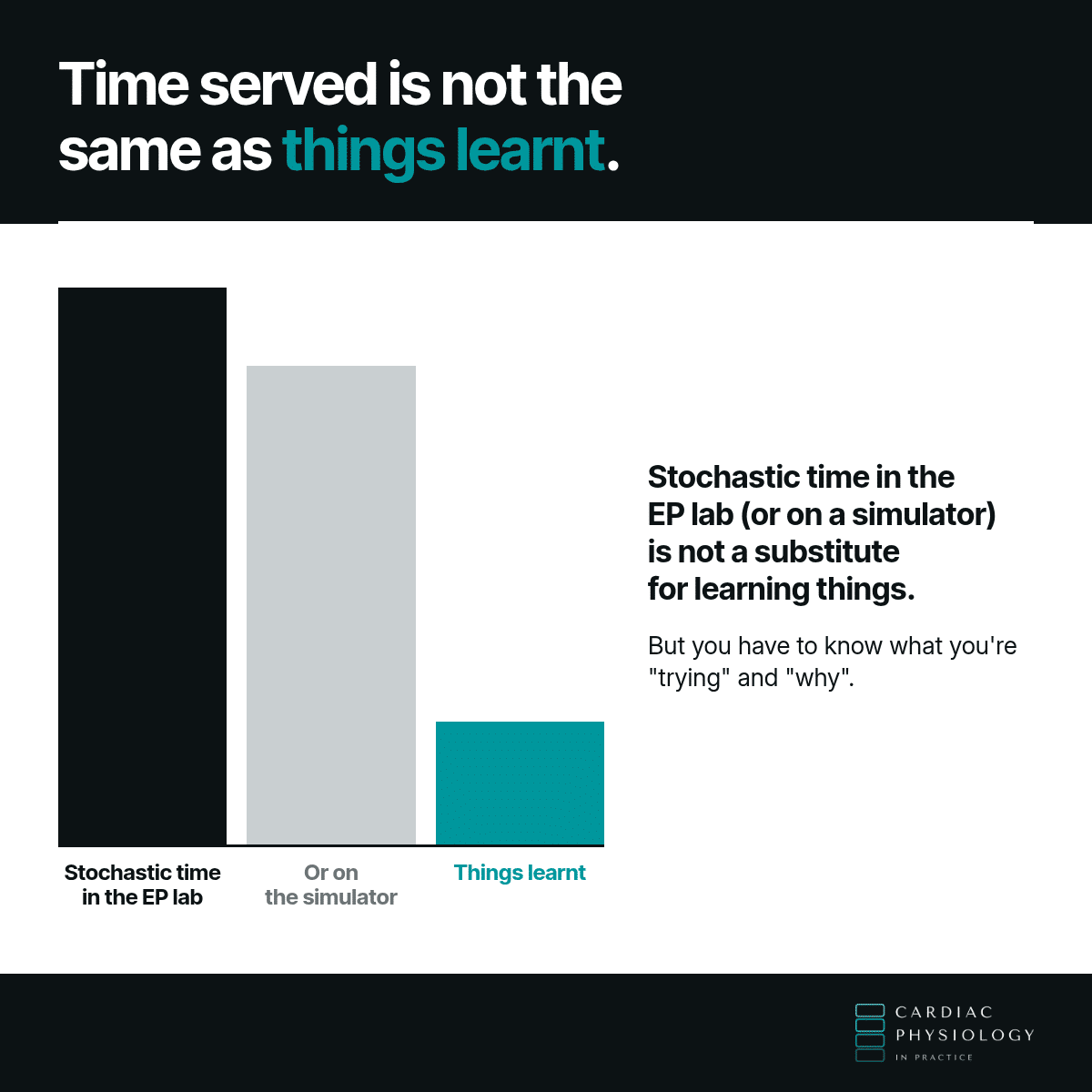
One of the great lies of EP training is that exposure automatically becomes understanding. It doesn’t. Stochastic time on a simulator isn’t learning. But honestly, neither is stochastic time in the lab. Watching 500 cases doesn’t magically teach someone why those cases behaved the way they did. Many people have been involved in 500 posterior wall isolations, but understand very little about the septopulmonary bundle anatomy & intramural fibre architecture of the LA and how it contributes to posterior wall recurrence.
First up, the technical prowess in these things is amazing.
Between them, the free ones let you place catheters under fluoro, drive a stimulator, decrement, induce, entrain the tachycardia, give drugs, ablate & then get a debrief on what was actually going on. Some generate cases from a conduction model, so what happens depends on what you do. Someone has sat down and coded the physiology…or at least asked AI to. That’s a serious amount of work, and a lot of it is being given away for free. That’s a boon for the EP community.
I wish I had one available when I was learning. Being able to pace the same SVT over & over until the manoeuvres made sense, without an EP waiting or yelling at me & a patient on the table? I would’ve loved that. I probably would have spent every one of my Sunday afternoons practicing for Monday.
So none of this below is a dig at the people building them….but I really have to say it because social media is all enthusiasm and no thought when it comes to these tools.
The simulator is not the antidote for a lack of knowledge. Simulators are much better at reinforcing understanding, than creating it. If you don’t know much in the lab, you still won’t know much in the simulator. You use them to practice what you already know, but are crap at performing under pressure.
This is where people confuse knowing with doing. When I was training, I knew what entrainment was. I had read all the original studies on entrainment, all day Sunday, every week. I knew when to do it. I knew how to interpret it.
Then the tachycardia started, everyone stared at me, the physician started yelling, and suddenly my hands forgot everything my brain supposedly knew. My hand mashed the keyboard, and the dreaded random calliper generator of the inexperienced EP Tech popped up on screen. I disappointed myself again by pacing too fast and then measuring something random.
These simulators might help avoid some of this. You can practice your AVJRT RV overdrive pacing, your parahisian pacing and your “non-random” measurements over and over and over and over again until its muscle memory, so that in a real case, you are less flustered and more chill under pressure.
But they don’t teach you how and why entrainment works, when it doesn’t or even what to measure and when. Simulators make a lot more sense once somebody has taught you the underlying EP principles.
The reason I care about this distinction is because I’ve seen too many people mistake activity or time for progress. They’ve spent hundreds of hours in labs. Dozens at conferences. And now maybe hundreds on simulators.
Yet if you take away the protocol and ask “why did that manoeuvre work? or “what differential did you not actually exclude with that manoeuvre?” the understanding often falls apart.
EP rewards understanding far more than attendance. The people who really stand out aren’t always the ones who have seen the most cases. They’re the ones who understand what they’re looking at and can steer a case in a productive direction.
The signals are modelled and clean, the catheter is where the label says it is, and the answer is one click away. Real cases aren’t that tidy.
But they give you the time to f@ck up and try again. And that’s valuable, because the lab doesn’t give you that. Nobody’s going to let you re-run a case because you mistimed your PVC, or worse yet, you misinterpreted aberrancy for VT.
But you have to know what you’re “trying” and “why”. If you don’t, you’re just clicking. Being told “correct” by a model you don’t understand isn’t knowing something. Mechanical repetition, muscle memory, and context-specific. Outside of that simulator context, it starts to unravel.

The sad reality is that most current simulators help a narrow range of people because competency itself develops in stages.
For that narrow range of people, simulators are great. But they get old real quick…
Once you can reliably predict what a particular simulator is going to do, you’ve probably exhausted much of what that simulator can teach you. That’s not necessarily a limitation of simulation itself. A more sophisticated simulator, with unfamiliar mechanisms, unpredictable responses, messy EGMs and increasingly difficult scenarios, could continue to challenge even experienced operators.
But there’s a point where repetition stops challenging your understanding and simply reinforces a familiar sequence of actions. You might become exceptionally good at navigating that simulator without becoming particularly good at understanding EP.
And that’s the distinction that matters.
If you’re no longer having to think critically about why something happened, what else could explain it, or what your manoeuvre actually excluded, then another hundred hours clicking through the same scenarios probably isn’t going to make you a better electrophysiologist or physiologist.
At that point, you’re better off:
Who should use an EP simulator?
Someone who already knows something, but needs to practice going through the motions. If you can interpret moving EGMs but you’re not yet at the point where you run cases independently to a minimum standard, a simulator gives you somewhere to make your mistakes and try again.
Is time on a simulator the same as learning EP?
No. Everyone understands why clicking around randomly on a simulator isn’t learning. Strangely, we don’t apply the same logic to the EP lab.
A fellow can spend three years standing beside an EP table and still possess fragile understanding. Exposure and understanding aren’t the same thing. Never have been.
What should experienced physiologists do instead?
Read studies, explore topics deeply, listen to John Mandrolas podcast to understand critical appraisal, review live difficult EGMs after the case, present difficult cases to colleagues & for the love of all things EP, enrol in a structured, proper in-depth dedicated EP course. There are way too many fellows and Physiologists flying by the seat of their pants every case. EP is hard enough as it is, don’t make it harder.
EP isn’t difficult because there are lots of manoeuvres. EP is difficult because the same manoeuvre can mean completely different things depending on the mechanism.
Simulators are impressive tools, and for the right person they’re genuinely useful.
But the bigger lesson has very little to do with simulators.
Time served is not the same as things learnt.
Not in a simulator.
Not in a conference.
Not in an EP lab.
Understanding has always been the bottleneck.
Thanks for tuning in :)
Cheers
Mitch
Further reading
Free EP simulators worth a look:
– SVT Ablation Lab: https://eplabsimulator.com/
– Ventriculus EP Lab: https://eplab.ventriculus.org/
– svtsim: https://svtsim.com/
– Virtual EP Lab (EP Tech Hub): https://eptechhub.com/virtual-ep-lab
– SimVT: https://simvt.vercel.app/
– LBBAP Implant Simulator: https://pacingsimulator.com/
Our course is only for those who want to dedicate some time and effort learning the nuances of EP and believe in going beyond the minimum standard: EP in Practice
EP in Practice – Product Overview