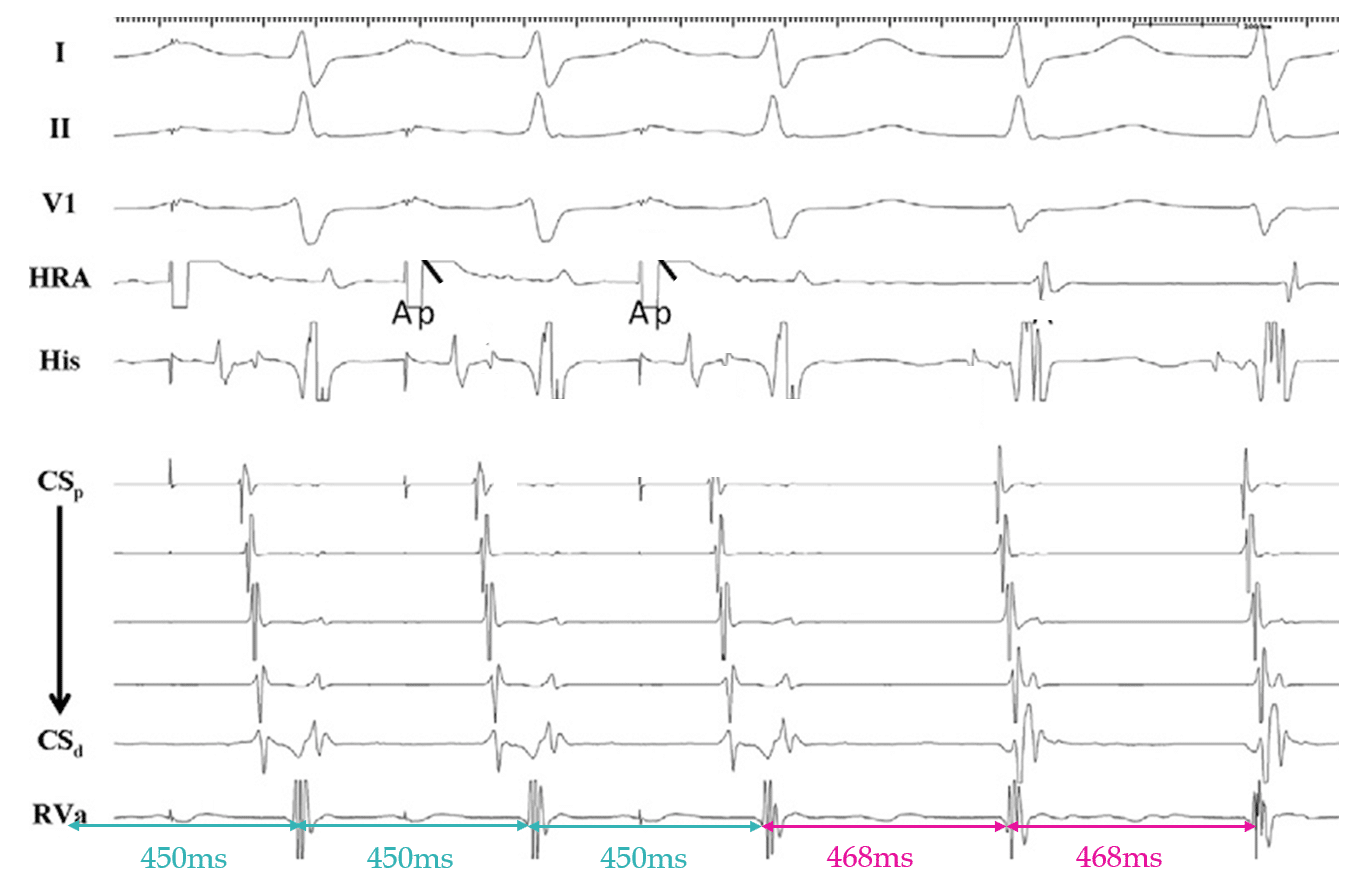
This EGM was obtained from a 46 year old female with presumed AVJRT. After many ablations in the slow pathway region, tachycardia could still be induced, arousing suspicion that perhaps this SVT was not typical AVJRT. Following this, atrial overdrive pacing was performed during tachycardia. What does the below result indicate?
(figure based on: Fan R et al. Novel use of atrial overdrive pacing to differentiate junctional tachycardia from AVNRT. Heart Rhythm. 2011;8(6):840–4)
(Click to zoom on image)
Answer:
Click to Show Answer
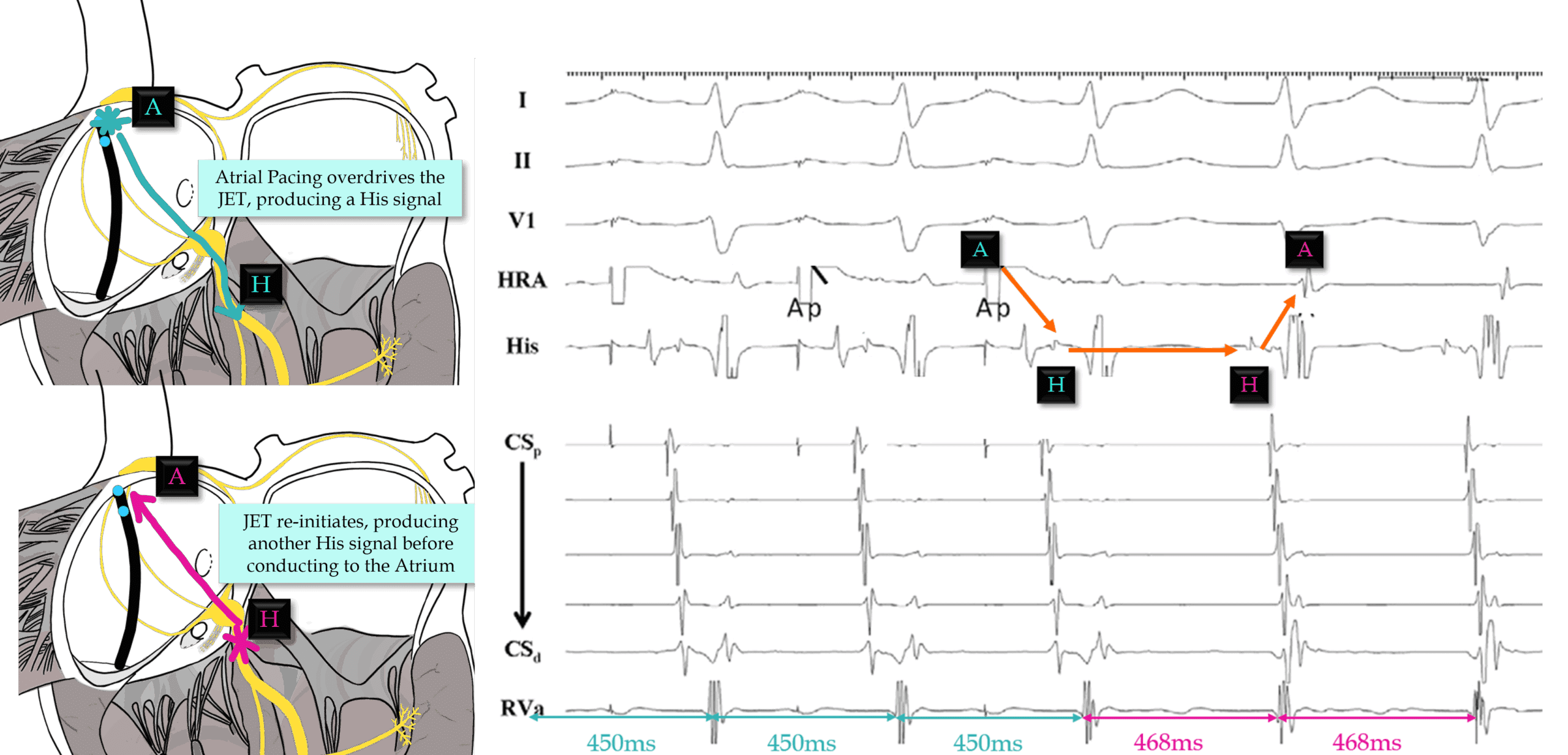
Answer: This EGM is diagnostic of a focal arrhythmia arising from the His Bundle/AV node due to an AHHA response following successful atrial overdrive pacing, consistent with Junctional Ectopic Tachycardia.
JETPrevalence:
Junctional Ectopic Tachycardia is a fairly rare phenomenon in Adults with a poorly understood pathogenesis probably involving enhanced automaticity from the AV nodal/Bundle of His region.
Some literature seems to dispute this “rare” narrative, describing a prevalence as high as 5% in patients with AVJRT ablation in the the days to weeks immediately following their ablation procedure.
Thisisknownas“SecondaryJET”or“PostOperative JET” and is usually a transient self-limiting phenomenon, induced by oedema and j=injury to the AVJ junction region poster surgery/ablation.
JET Presentation in the EP lab.
Since the JET arises from the AV node, it’s presentation appears very similar to typical AVJRT, with a short VA time of <70ms, and the earliest A occurring in the His A catheter (close to the AV node).
Importantly,itdoes not necessarily initiate with an AH jump, helping us differentiate it from AVJRT.
ItalsotendstooscillatemorewildlyintachycardiaCL,andVAblockduringtachycardiaiscommonlydescribed.These can occur in AVJRT, but lend evidence towards JET.
JETAblation:
Will be a topic for another day. Suffice to say, that ablation requires closer proximity to the AV node, with higher risk of AV block, lower procedural success and higher risk of recurrence.
The below illustration attempts to recreate sites of attempted JET ablation and demonstrates perilous proximity to the AV node where catastrophic injury to the AV node is risked with ablation. For this reason, JET ablation is often abandoned in favour of medication, or performed with cryomapping and cryoablation. Alternative methods, such as ablation from the NCC have been proposed, but are not the subject of todays discussion.
Atrial Overdrive Pacing
Pacing the atrium 20ms faster the the TCL is useful in differentiating JET from AVJRT in patients with 1:1 AV conduction.
You must accelerate tachycardia to your pacing cycle length and the tachycardia must continue at it’s original TCL.
An AHHA response is diagnostic for JET.
An AHAH response indicates Reentry (AVJRT/AVRT).
Top tip: Always confirm your last entrained His/V signal! Measure it, don’t assume it.
My Two Cents:
JET should always be suspected in the setting of a short VA tachycardia, especially when the TCL oscillates wildly, theres spontaneous VA block during tachycardia or slow pathway ablation fails to abolish tachycardia.
JET can be differentiated from AVJRT by performing Atrial Overdrive pacing (assuming 1:1 AV conduction is present).
An AHHA response is diagnostic for JET in most circumstances.
Thanks for tuning in :)
Cheers
Mitch & CPiP Team
This BeatBox post was based on the JET lectures contained in the Complex SVT Program 4, part of EP in Practice. EP Mastery in 2 years. No shortcuts. No compromises.
(Question image based on) – Fan R, Tardos JG, Almasry I, Barbera S, Rashba EJ, Iwai S. Novel use of atrial overdrive pacing to rapidly differentiate junctional tachycardia from atrioventricular nodal reentrant tachycardia. Heart Rhythm. 2011 Jun;8(6):840-4.
Majumdar S, Mohanan Nair KK, Namboodiri N, Valaparambil A. Response to atrial overdrive pacing during narrow QRS tachycardia. What is the mechanism? Indian Pacing Electrophysiol J. 2020 Sep-Oct;20(5):203-205.
Alasti M, Mirzaee S, Machado C, Healy S, Bittinger L, Adam D, Kotschet E, Krafchek J, Alison J. Junctional ectopic tachycardia (JET). J Arrhythm. 2020 Jul 27;36(5):837-844.
Dar T, Turagam MK, Yarlagadda B, Parikh V, Pillarisetti J, Gopinathannair R, Gianni C, Mohanty S, Mansour M, Di Biase L, Bunch TJ, Natale A, Lakkireddy D. Outcomes of junctional ectopic tachycardia ablation in adult population-a multicenter experience. J Interv Card Electrophysiol. 2021 Jun;61(1):19-27.