
Combining Pacemapping with VT Localisation

Question:

Below is an example of an initial pacemap during a scar-related VT ablation. Compare the pacemap morphology to the native VT morphology. Given this, where is the successful pacemap likely to be located?

(Click to zoom on image)

Answer:

Answer: The best pacemap is likely to be located more basal to the current pacemap, since the native VT morphology displays greater precordial positive concordance relative to the pacemap morphology.


Pacemapping – the 12/12 scoring system is obsolete

Pacemapping is frequently used in the context of idiopathic PVC ablations but is also a cornerstone of scar related VT ablations for ischaemic and non-ischaemic cardiomyopathies.


Traditionally, pacemapping was scored using a 12/12 or a 24/24 score system, however, modern technologies provide more objective quantification of the pacemap correlation value, rendering this scoring system obsolete, however, EP Physiologists should remain actively involved during the pacemapping process.

Pacemapping can be used to:

  • Identify VT exit sites


  • Identify possible diastolic corridors


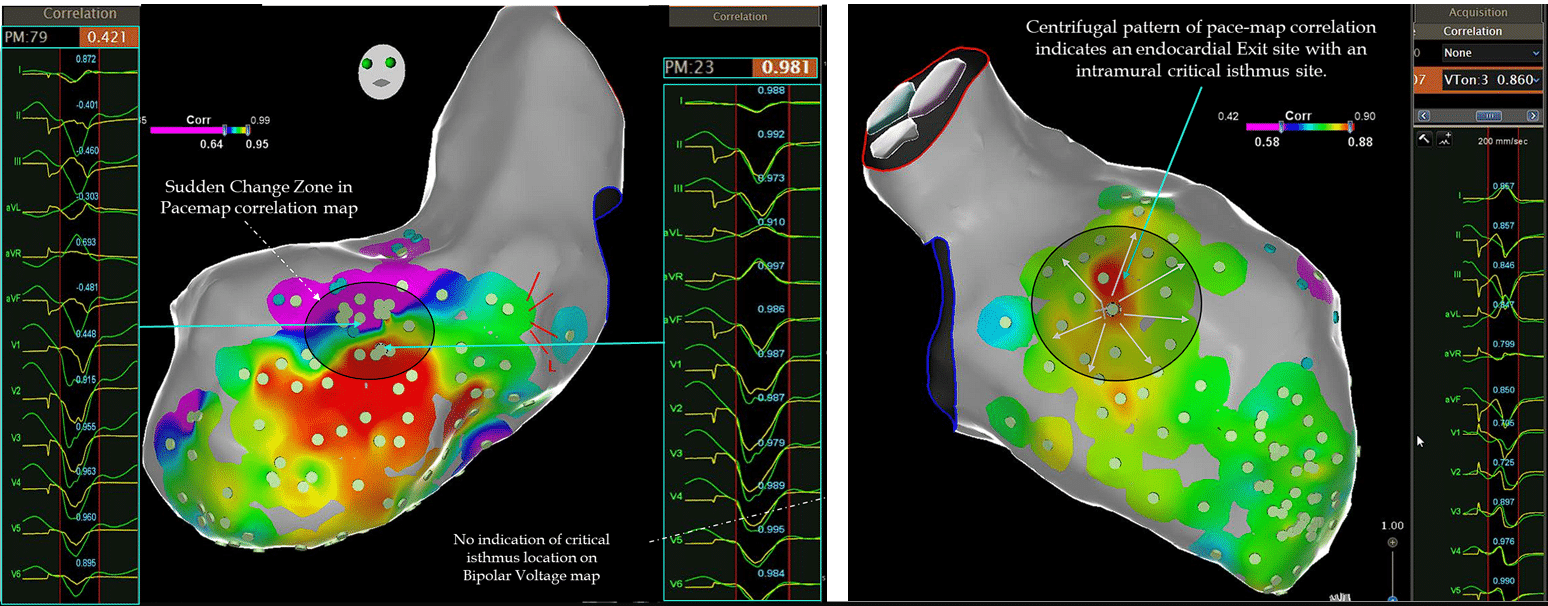
Below is an example of an endocardial critical isthmus site (left) and an intramural isthmus site (right) identified entirely with pacemapping.
 

Guiding Pacemapping with VT Localisation knowledge

EP Physiologists should use strong VT localisation knowledge to help guide pacemapping, contributing to precision and efficiency of mapping out favourable target sites for ablation.

Initially, pacemapping is based on the native VT morphology.

  • Based on the native VT morphology below, we’d expect the VT exit site to be located on the mid cavity LV inferior wall.


  • Bipolar Voltage map also demonstrates a significant scar burden in this region. Hence, VT pacemapping has been initiated in this location.


Comparing pacemap vs native VT morphology

Once pacemapping has been performed, the pacemap morphology (yellow) should be compared to the native VT morphology (green) and the differences used to guide the next pacemapping location.


  • For example, the above VT morphology is MORE POSITIVE in V3-V6 compared to the pacing morphology, which transitions to a negative QRS in V5.


  • This indicates that the native exit site is located more basal, relative to the current pacing site.


Below are several more examples of how this can be applied and communicated. The process should follow 3 steps.

 

  1. Which leads have the worst pacemap correlations?
  2. What is the difference between the pacemap and the native VT in those leads?
  3. Where should the catheter go?


RV based example


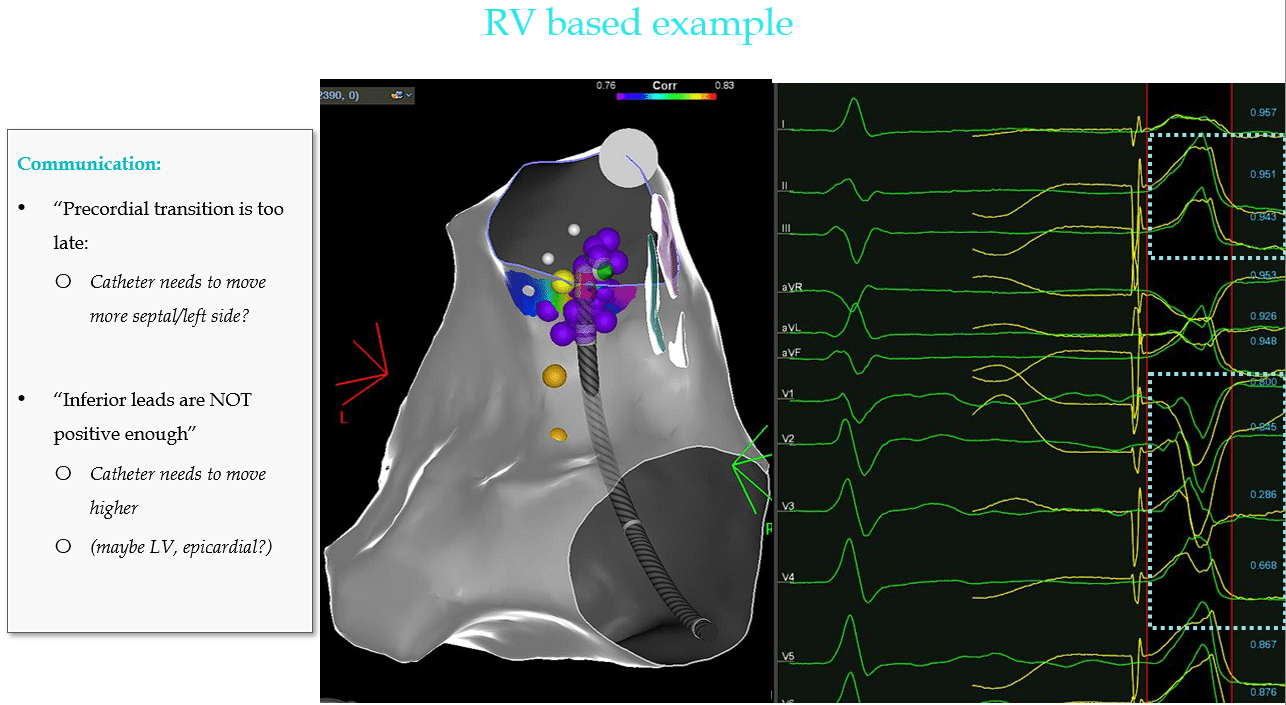
The above example involves pacemapping just beneath the pulmonary valve, however, the pacemap results in insufficient amplitude of the inferior leads.

  • This could indicate that the true VT origin is above the pulmonary valve (where coronary injury is risked during ablation)


  • It could also indicate an epicardial VT origin.


The above example also demonstrates a precordial transition which is insufficiently early in the paced morphology.

  • The native VT transition is in V3 (green) and the paced transition is in V4 (yellow).


  • This could perhaps indicate the true VT origin site is more septal than the current catheter position, perhaps even on the LV side of the septum. 


My Two Cents:

  • EP Physiologists should actively participate in guiding the pacemapping process and it is insufficient to simply call out “75%” correlation.


  • VT Localisation techniques can be used to guide the pacemapping process.


  • Start with identifying the worst correlation leads.


  • Compare the VT and the pacemap morphology in those leads to guide catheter manipulation & pacemapping.


Thanks for tuning in :)
Cheers
Mitch & CPiP Team.

This BeatBox Blog post was based on the newest lecture uploaded to the idiopathic VT ablation Program 6 on “Advanced Pacemapping Techniques”. Enrol in EP in Practice here for the ultimate EP Education curriculum.

Leave a Reply

Subscribe to stay informed

Get the latest updates and event details, and be notified when new courses launch.